Space in a space with the traces of its own making

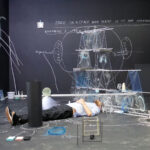
SPACE IN A SPACE WITH THE TRACES OF ITS OWN MAKING
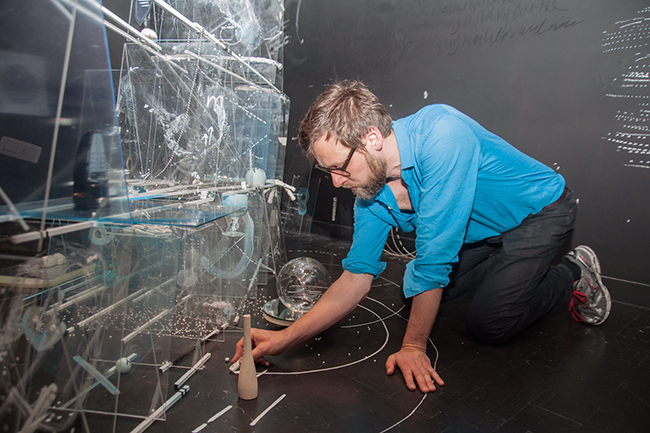
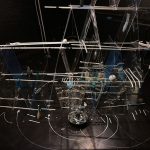
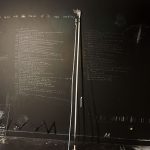
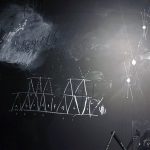
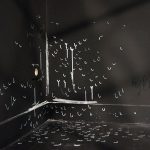
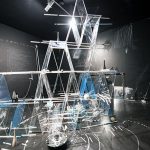
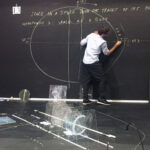
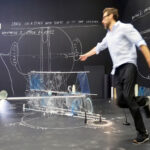
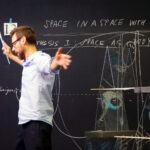
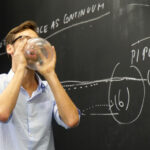
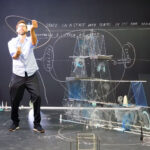
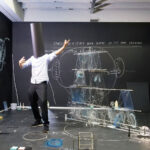
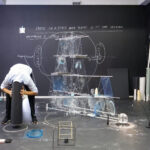
IIn the work of Nikolaus Gansterer „Space in a Space with the Traces of its own Making (2017)“, the processes of thought, action and drawing are indissolubly interconnected and complementary: A stream of consciousness is transformed into gestures, interaction with objects, drawings and formulae setting up a highly complex embodied spatio-temporal diagram. In reference to the work of Robert Morris „Box with the Sound of Its Own Making“ (1961) Gansterer is interested in mapping and thematizing the enabling conditions of art practice in itself and even taking it a step further.
Nikolaus Gansterer states: „I do cultivate practices of taking notes and annotations where space is not a neutral and theoretical entity but becomes a vivid and vibrant field of forces to be inhabited with my whole body, with all my senses, with a practice which is rather process than product-orientated, a practice which is moving through, moving with and moving along these lines of flight and a practice which is gaining a specific momentum – „where space is becoming at once result and cause, product and producer“(…) so to say space is becoming an „auto-poietic system“ (in the sense of Humberto Maturana & Francisco Varela) or even a „sympoietic system“ (in the sense of Beth Dempster and Donna Haraway). A system, or rather an organism which is rather putting focus on the emergence of presence than on re-presentation. This dynamic understanding of space-time means that space itself is not understood as a neutral nor empty container – but more understood as an ecology – which is playing a constitutive role in co-shaping these creative and inter-subjective processes that again determine the trinity – of the representations of space, the spatial practices, and the representational spaces (…) at least how I understood how Henri Lefebvre framed it.“
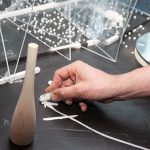
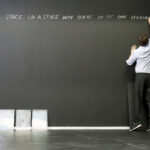
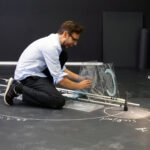
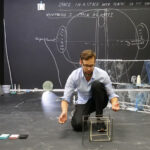
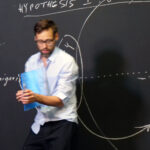
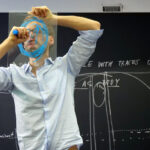
The visitors are able to witness the manifestation of a strong syncretism between art and research or rather art-as-research, which aims to investigate the intrinsic connections between both fields. Here, the gallery space for Nikolaus Gansterer becomes a space for (self-)experimentation where drawing is shown as the result of a complex choreography of thought processes developed and concretised through a series of performative actions in relation to the materials and artifacts in space.
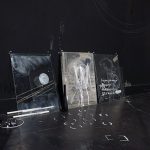
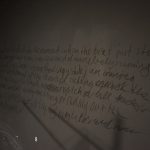
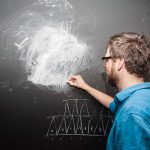
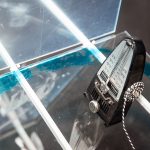
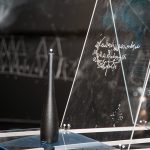
The aim is to give a conceptual representation of a makeshift and enactivist model of the mind in constant evolution, which is precisely documented by a protocol of actions. Graphs, blackboards, diagrams, maps and systems of signs which apparently hark to scientific theories, all become traces of their very existence, an ephemeral testimony which open onto a speculative and poetic horizon of a drawn hypothesis.
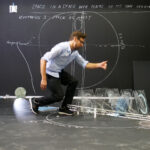
One year after the exhibition, Gansterer re-opened the work as a durational performance at A Performance Affair in Brussels (2018). What had unfolded as a private working process over the days of the gallery show now became a public act, carried out in front of an audience. Over the course of the performance, visitors stayed with the work as it happened and watched the space gather its own traces in real time. Paper, objects, mirrors, glass and sound extended the range of materials, with the mirrors and glass folding the space back onto itself, so that the making and the made were held within a single view.
What sets this second iteration apart is the direction of the process. In the gallery, thought had settled into gesture and gesture into material trace. In the live situation the movement also runs the other way: the accumulated traces, objects and surfaces become a vocabulary for movement, and the installation is translated back into the body. Understood in this way, the work defines itself as a spatial practice that carries Morris’s proposition further. Where Morris moved the question from the object to the room, here the room itself gives way to an expanded and fluid spatiality, a field of relations in movement rather than an Euclidean- Newtonian space conceived as box. Gansterers practice of the translecture leaves the table and takes this entire temporal-spatial field as its surface for writing, thinking and drawing.
Nikolaus Gansterer states: „In the performance the installation is translated back into a vocabulary of movement. The mattering of the material passes over into bodily affairs: thought becomes movement, movement becomes material, and material becomes thought again. When thought becomes matter and matter turns into thought, drawing keeps (me) moving between the two.“
Artist: Nikolaus Gansterer
Title: Space in a Space with the Traces of its own Making
Year: 2017-2019
Materials: Paint, chalk, charcoal, acrylic glass, pencil shavings, wooden sticks, gestures, movement material,…
Dimensions: variable
Exhibition: Drawing Praxis, Gallery Marie-Laure Fleisch, Brussels, 2017
Performance: Space in a Space with the Traces of Its Own Making, durational performance and installation, various materials, paper, objects, mirrors, glass, sound, A Performance Affair, Vanderborght Building, Brussels, 2018